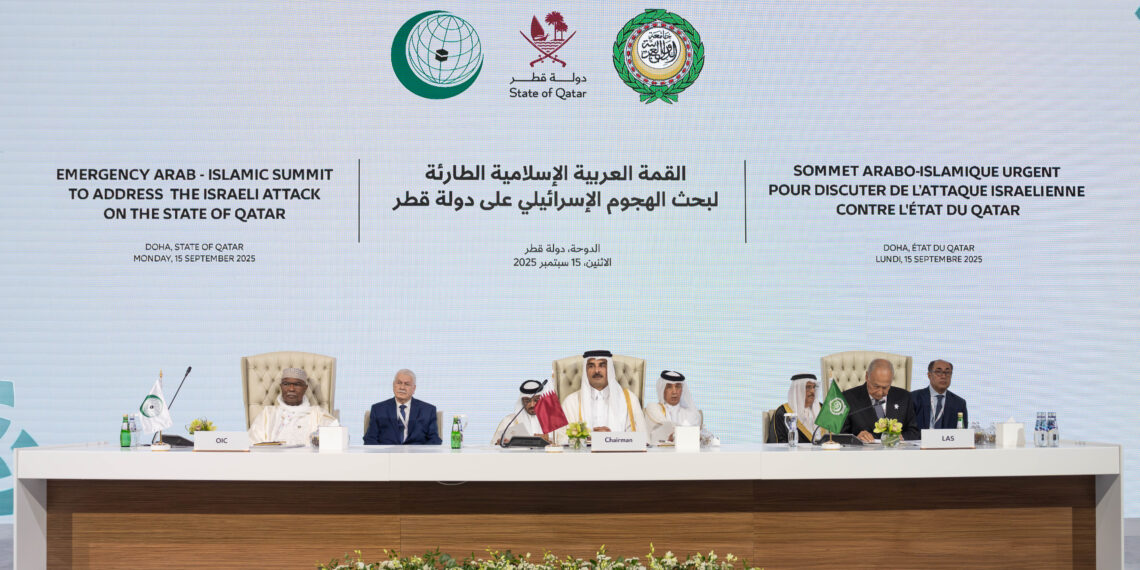
The Qatari Ministry of Defense announced that its air defenses successfully intercepted a missile attack targeting Al Udeid Air Base, confirming that no casualties or significant damage had occurred. The attack sparked widespread condemnation from several Arab countries, which viewed the operation as a blatant violation of Qatari sovereignty and airspace, as well as a breach of international law and the United Nations Charter.
Saudi Arabia expressed strong condemnation of the Iranian aggression against Qatar, stating that the attack constitutes a flagrant breach of international law and the principles of good neighborliness, and cannot be justified under any circumstances. Egypt also condemned the attacks in the strongest terms, affirming that they were a violation of Qatar’s sovereignty and a threat to the safety of its territory. It expressed deep concern over the dangerous escalation in the region and rejected any form of military escalation.
For its part, the United Arab Emirates strongly condemned the targeting of Al Udeid Air Base by the Iranian Revolutionary Guard, affirming its full solidarity with Qatar and its support for the protection of its citizens’ safety and security. It stressed that such acts of aggression threaten the security and stability of the region. Bahrain also expressed its full support for Qatar, emphasizing the importance of restraint and avoiding escalation. It called on the international community and the UN Security Council to assume their responsibilities in condemning the attack and taking steps to deter Iranian actions, and to work toward restoring regional stability.
In the same context, the Sultanate of Oman expressed its disapproval of the regional escalation, noting that the Iranian shelling constituted a violation of Qatari sovereignty and contradicted the principles of good neighbours relations. It warned of the expanding scope of the conflict, which could lead to further harm in the region.
Kuwait also condemned the Iranian attack on Al Udeid Base, describing it as a dangerous escalation that threatens regional peace and security. Iraq expressed deep concern over the accelerating escalation, stating that the targeting of Qatar represents a dangerous turning point that could intensify regional tensions. Iraq stressed the importance of preventing the involvement of new parties in the conflict in order to preserve security and stability.
Jordan affirmed its strong condemnation of the attack, considering it a violation of Qatar’s sovereignty and international law, and reiterated its full solidarity with Qatar in facing any threat to its security and stability.
Morocco also expressed its strong condemnation of the attack, affirming its full solidarity with Qatar in the face of any infringement on its security or the well-being of its citizens.
Meanwhile, the Secretary-General of the Gulf Cooperation Council (GCC) condemned the Iranian attack, calling it a flagrant violation of Qatari sovereignty and a threat to the security of the GCC member states. He stressed that the security of the GCC states is indivisible, and that the Council stands united with Qatar against any threat to its security.
The Secretary-General added that Qatar and the GCC countries had made efforts to achieve a ceasefire and mediate in the Iranian-Israeli conflict, and were surprised by this missile attack, which constitutes a breach of international laws and established norms.
The Arab Parliament also condemned the attack, describing it as a flagrant violation of the rules of international law. It reiterated its warning against the expansion of the conflict in the region, which could undermine security and stability.
Lebanese President Joseph Aoun condemned the assault, viewing it as an action that increases tension and broadens the scope of military confrontations. He emphasized its negative impact on efforts to de-escalate and return to dialogue.
Likewise, the Palestinian Authority expressed its condemnation of the Iranian attack, affirming its solidarity with Qatar and its brotherly people.
This widespread Arab condemnation comes at a time of escalating regional tensions, as countries urge restraint and a return to dialogue and diplomacy to avoid further escalation and to safeguard security and stability in the Gulf and the Middle East more broadly.