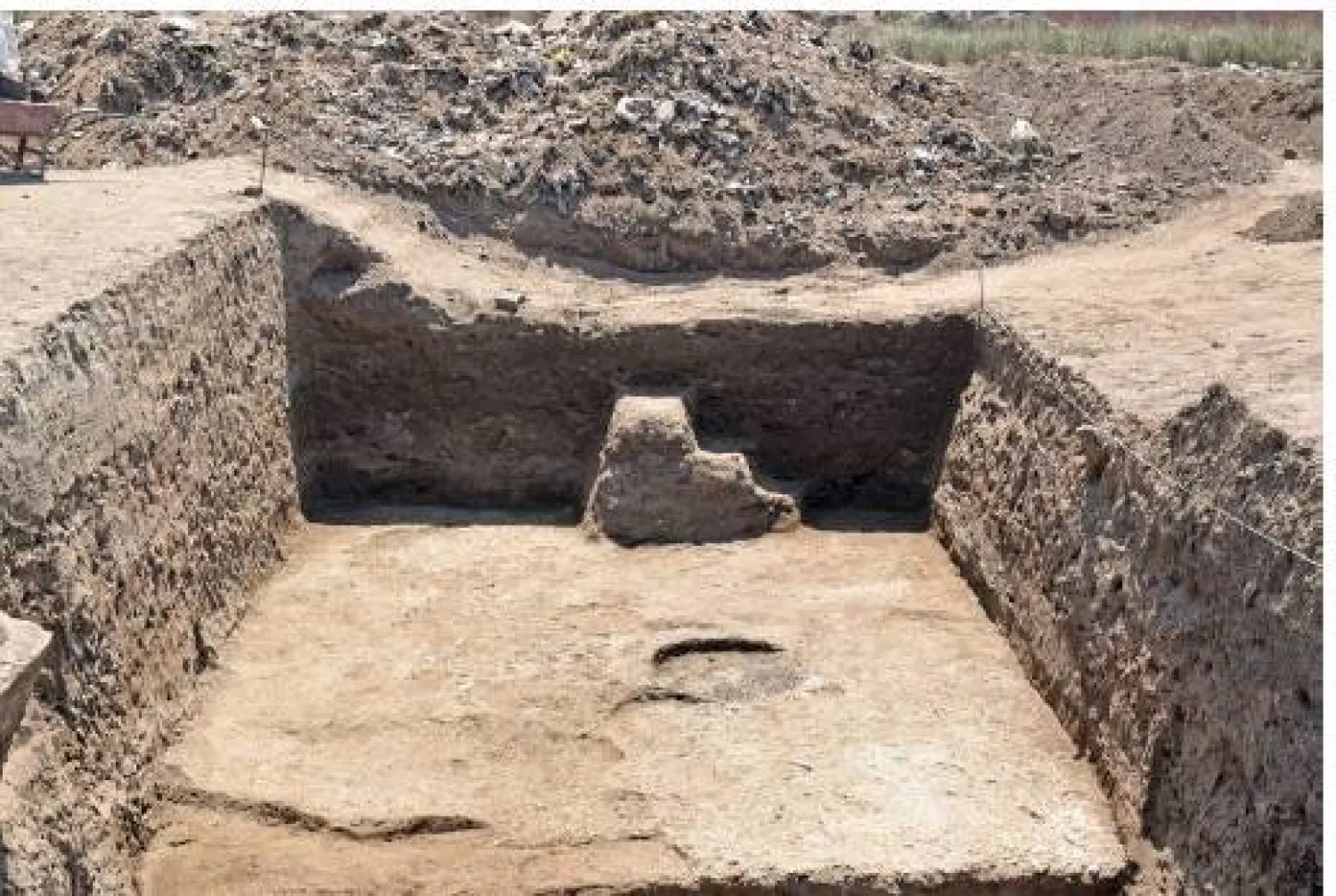
The Egyptian Ministry of Tourism and Antiquities announced a new archaeological discovery in the Tell el-Faraoun area of Sharqia Governorate, northern Egypt. A British archaeological mission affiliated with the University of Manchester discovered the ruins of an ancient city known as “Emet,” dating back to the early or mid-4th century BC.
An official statement issued by the ministry explained that the excavations revealed a group of residential buildings believed to be multi-story “tower houses,” designed with thick walls to support their weight. This was an architectural style common in the Nile Delta region during the Late Period and up to the Roman era.
The director of the archaeological mission, Nicky Nielsen, indicated that the city of Emmet was one of the most important population centers in Lower Egypt, especially during the New Kingdom and Late Periods. He pointed out the presence of a huge temple dedicated to the ancient Egyptian goddess “Wadjet,” whose ruins still stand on the western side of the discovered site. He added that among the discoveries are also architectural remains likely to belong to a road used for religious processions, linking two monuments, one from the Late Period and the other from the Wadjet Temple. This road appears to have fallen out of use by the middle of the Ptolemaic period.
For his part, the Secretary-General of the Supreme Council of Antiquities, Mohamed Ismail Khaled, explained that the excavations relied on remote sensing techniques and satellite imagery to locate dense brick clusters, which helped direct excavations to promising areas.
The Head of the Egyptian Antiquities Sector, Mohamed Abdel Badie, also indicated that the discovery provides new information about daily life and religious practices during that era, emphasizing its importance in deepening the archaeological understanding of the region’s history. Among the most notable finds discovered during the excavations is the upper part of an ushabti statue crafted from green faience with great precision, believed to date back to the Twenty-sixth Dynasty. A stone stela depicting the god Horus standing on two crocodiles, holding snakes, with the god Bes in the center, is also found. A bronze musical instrument known as a sistrum, decorated with the heads of the goddess Hathor, dates back to the late Late Period.